A residential proxy is a service that routes your traffic through an IP address issued by a real internet service provider to a home or mobile device. The practical effect: the site you're visiting sees a household IP instead of your actual connection. That single swap explains almost everything else about residential proxy meaning, including why the technology gets used for both legitimate research and outright fraud.
TL;DR:
- Residential proxies use IP addresses assigned by ISPs to real households, making traffic appear like genuine user activity from specific regions.
- IP rotation methods vary from per-request to sticky sessions, affecting tasks like scraping or account management, with faster rotation ideal for volume and slower for stability.
- Quality depends heavily on transparent, consent-based sourcing; proxies built on compromised devices pose legal, ethical, and performance risks.
- Residential proxies are more expensive than datacenter options due to sourcing costs and performance trade-offs like higher latency and lower throughput.
- Proper evaluation includes verifying sourcing transparency, policies against fraud, and testing against target sites before large-scale deployment.
Table of Contents
- What Is a Residential Proxy and How Do Sites Read Residential IPs?
- How Do Residential Proxies Rotate and Target Locations?
- What Types of Residential Proxies Exist?
- How Do Providers Source Residential IPs Ethically?
- What Are Residential Proxies Used for Legitimately and Illegitimately?
- How Are Residential Proxies Detected?
- What Do Residential Proxies Cost?
- How Do You Evaluate a Residential Proxy Provider Safely?
- Why Twitchpanel Uses Residential IP Support for Creator Growth
- The Part of This Story Most Explainers Leave Out
- Sources
What Is a Residential Proxy and How Do Sites Read Residential IPs?
The traffic path is simple: your device sends a request to the proxy, the proxy forwards it's using an ISP-issued address, and the destination server responds as if a regular home user made the request. That IP substitution is the entire trick. Nothing about your browser or your data changes; only the address stamped on the request does.
What makes an IP "residential" is its origin. An ISP assigns it to a household or mobile subscriber, which means it's registered under a consumer network block rather than a commercial hosting range. Anti-bot systems and geolocation tools lean heavily on that distinction. A request from a known datacenter ASN gets flagged or challenged far more aggressively than one from a Comcast or Vodafone residential block, because fraud teams know real people don't run thousands of requests per second from home. This is the definition of a residential proxy that actually matters in practice, not the marketing version.
Most services support standard protocols, primarily HTTP, HTTPS, and SOCKS5, so they slot into existing scraping scripts or browser configurations without custom tooling. Sessions can last a single request or persist across a browsing sequence, depending on what the provider offers and what the task requires. A residential proxy routes traffic through a real ISP-issued consumer IP, which is why destination sites treat that traffic as ordinary household activity rather than automated access.
How Do Residential Proxies Rotate and Target Locations?
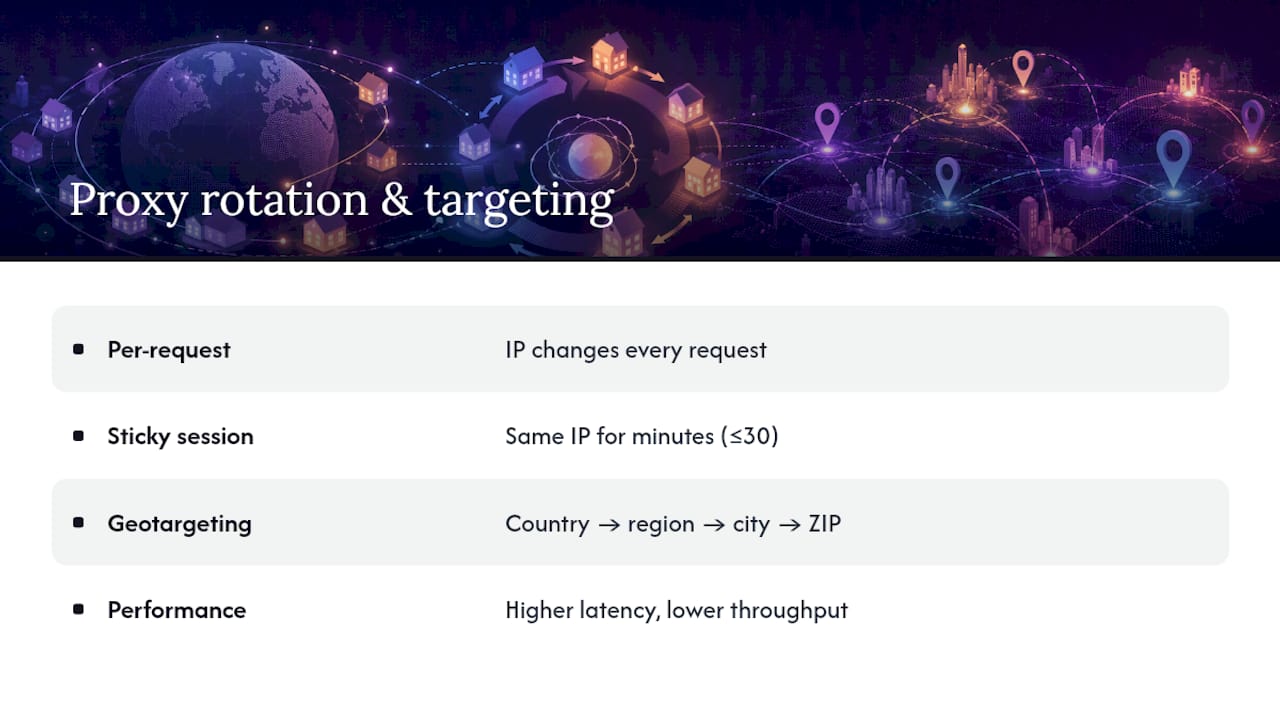
Rotation is where residential proxy services actually differ from each other, and it matters more than most buyers realize. A pool might rotate the IP on every single request, which is ideal for scraping thousands of pages where continuity doesn't matter. Or it can hold a "sticky session," keeping the same IP for a set window, usually anywhere from a few minutes to 30 minutes, so a login or shopping cart doesn't break mid task.
Providers implement rotation models like per-request and per-session cycling, and picking the wrong one causes most of the frustration people report with residential proxies. Fast rotation is great for broad data collection but terrible for anything requiring a stable identity, like managing a social account or holding a checkout session.
Geotargeting is the other half of the equation. Decent providers let you pick a country, and better ones narrow to a region, city, or even ZIP code, by matching your request to IPs registered in that geographic pool. This is why ad verification teams and localized SEO checks rely on residential proxies almost exclusively. A datacenter IP can't convincingly claim to be a phone in Cleveland.
Performance is the trade-off nobody advertises upfront. Residential connections run through consumer networks, so latency tends to run higher and throughput lower than datacenter alternatives. You're borrowing bandwidth from someone's home router, not a server rack built for speed. For workloads where realism matters more than raw throughput, that's an acceptable exchange.
What Types of Residential Proxies Exist?
Four categories cover almost every service on the market, and they aren't interchangeable.
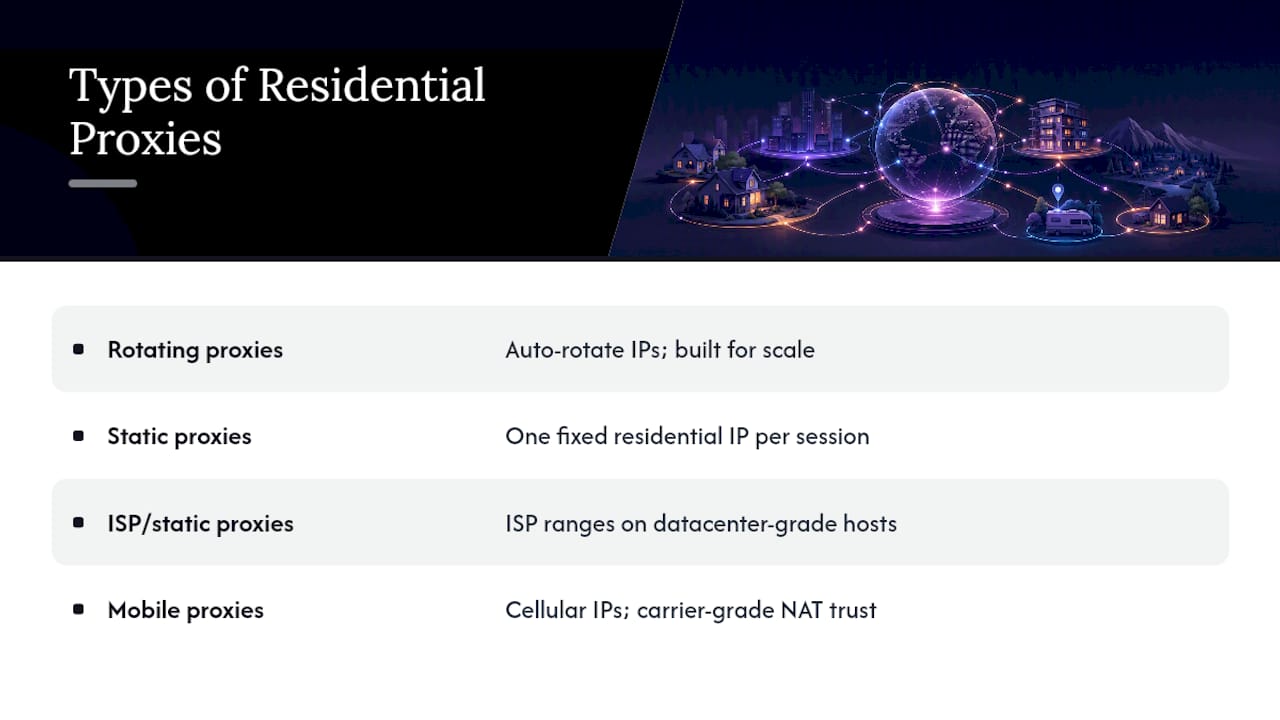
Rotating residential proxies cycle through a large pool automatically, often on every request. They're built for scale: scraping thousands of product pages, checking search rankings across regions, or verifying ads at volume.
Static residential proxies assign one IP that stays fixed for an extended period, sometimes indefinitely, while still originating from a genuine residential range. These fit account management tasks where switching addresses mid-session would trigger a security flag.
ISP or static-residential proxies are a hybrid: addresses drawn from ISP-registered ranges but hosted on stable datacenter-grade infrastructure. They aim for residential trust with datacenter reliability, and they've become a pragmatic middle ground for enterprise workflows that need both.
Mobile proxies route through cellular carrier IPs specifically, which carry even more trust than fixed-line residential addresses because carrier-grade NAT makes each address look shared by design.
Against datacenter proxies, the trade is speed and cost versus believability. Datacenter IPs are cheap, fast, and abundant, but datacenter IPs originate from commercial hosting providers and get flagged more readily than residential ones. VPNs, meanwhile, solve a different problem entirely: personal privacy and encryption for one user, not distributed access across many IPs for scraping or automation at scale.
How Do Providers Source Residential IPs Ethically?
This is the part of residential proxy meaning that most explainers skip, and it's the one that actually determines whether a service is trustworthy.
Legitimate providers build their IP pools through consent, usually by partnering with free VPN apps or SDKs where users opt in to share bandwidth in exchange for a free service. The device owner knows, at least in the fine print, that their connection might route someone else's traffic.
The non-consensual version looks very different. The FBI has publicly warned that compromised devices, including IoT gadgets like routers and smart cameras, get co-opted into proxy networks without owners' knowledge. Malware quietly turns a home router into a proxy node, and the owner never sees a notification. This is not a hypothetical edge case; it's a real, scalable method attackers use because IoT devices are numerous and rarely monitored for outbound behavior.
Sourcing affects more than ethics. Proxies built on compromised devices get burned faster, since fraud teams eventually correlate the abuse pattern back to the ASN, and using them can expose you to legal risk depending on your jurisdiction and use case.
Look for these signals before trusting a provider:
- A public, specific explanation of how the IP pool is sourced, not vague language like "global network."
- An opt-in program disclosed to the end users whose bandwidth is being used.
- A clear acceptable-use policy that explicitly bans fraud, credential stuffing, and account takeover.
- Willingness to answer direct sourcing questions from support rather than deflecting.
Pro Tip: If a provider can't explain in one sentence where its residential IPs actually come from, treat that as a hard no, regardless of how cheap the plan is.
What Are Residential Proxies Used for Legitimately and Illegitimately?
The same technical capability serves opposite purposes depending on intent, which is the core tension in residential proxy meaning.
- Ad verification — agencies check that ads render correctly and aren't hijacked across different regions and devices.
- Localized QA and testing — engineering teams confirm a site or app behaves correctly for users in specific countries before launch.
- SEO and SERP monitoring — marketers track search rankings as they actually appear to searchers in different cities, since Google personalizes by location.
- E-commerce price monitoring — retailers watch competitor pricing without getting geo-blocked or rate-limited.
- Social media account management — creators and agencies manage accounts tied to specific regions where login location matters.
On the abuse side, the exact same routing powers automated fraud, ban evasion after a platform blocks an abusive account, large-scale scraping that violates terms of service, ticket scalping bots, and credential-stuffing attacks designed to look like distributed human logins. The technology doesn't distinguish intent. Only the operator's behavior does.
How Are Residential Proxies Detected?
Detection teams rely on a stack of signals, not one silver bullet. ASN and WHOIS lookups flag the IP's registered owner, but that alone won't catch a genuine residential address being abused. IP reputation databases track addresses previously linked to spam or scraping, and behavioral analysis looks for request patterns no human produces, like perfectly timed intervals or identical navigation paths across thousands of sessions.
Browser fingerprinting and TLS client-hello inspection add another layer, catching mismatches between the claimed device and the actual software making the request. Residential IPs slip past a lot of bulk-detection heuristics precisely because they look like normal traffic on paper. That's their whole value proposition to buyers, and it's exactly why classifiers increasingly weigh behavior over origin. A residential IP making 500 requests a minute still gets caught, just on a different signal.
What Do Residential Proxies Cost?
Pricing runs on a few common models: per gigabyte of bandwidth, per dedicated IP, or a flat subscription tied to a session or request cap. Residential proxy pools can number in the tens of millions of addresses, and that scale, plus the sourcing cost behind it, is why residential plans run noticeably higher than datacenter pricing per gigabyte.
What moves the price beyond the base rate: how granular the geotargeting is (city-level costs more than country-level), how frequently IPs rotate, whether you get exclusive access to an IP versus sharing a pool, and how transparent the provider is about sourcing. Cheaper plans often cut corners on exactly the sourcing hygiene that matters most.
How Do You Evaluate a Residential Proxy Provider Safely?
Match the proxy type to the actual job before comparing vendors. The right choice between residential, datacenter, and mobile proxies depends on the target site's defenses, not on which option a sales page calls "best."
Run through this checklist before signing up:
- Does the provider disclose how it sources IPs, and does that explanation hold up to a follow up question?
- Is there a published acceptable-use policy that bans fraud and account takeover?
- What's the logging and retention policy for your activity?
- Is there a real SLA or uptime guarantee, or just a marketing promise?
- Can support answer specific technical questions, not just billing ones?
Red flags worth walking away from: pricing that undercuts the entire market with no explanation, sourcing language that stays vague no matter how you ask, and a company registered in a jurisdiction with no accountability mechanism.
Once you've picked a provider, keep your own usage clean. Rate-limit your requests to mimic human timing, manage sessions deliberately instead of rotating when continuity matters, and always respect the target site's terms of service.
Pro Tip: Test a small batch of requests against your actual target site before committing to a large plan. Detection behavior varies wildly by site, and no provider's marketing page will tell you how their pool performs against the specific defenses you're up against.
Why Twitchpanel Uses Residential IP Support for Creator Growth
Twitchpanel builds residential IP support into its viewer and engagement delivery because authentic-looking traffic matters more than raw speed when a creator is trying to grow a channel that platforms actively monitor for artificial activity. Ramp-ups land within 1 to 3 minutes, backed by direct native API integration, so creators see results without the delays that come with manual processing or KYC paperwork.
Every service runs through automated systems around the clock and settles instantly through crypto payments, no account verification required. That said, residential IP support is a delivery method, not a loophole. Creators are responsible for following the rules of whatever platform they're growing on, and for understanding local law around automated engagement. For specifics on how Twitchpanel structures its Twitch, Instagram, and TikTok growth services, visit the Twitchpanel service marketplace.
The Part of This Story Most Explainers Leave Out
Most residential proxy content treats the technology as a neutral utility, a faster VPN with better disguise. That framing undersells the actual stakes. The FBI didn't issue a public alert about datacenter proxies. It issued one about residential proxy networks specifically, because the sourcing model creates a victim class that never signed up for anything: homeowners whose routers get quietly hijacked and turned into someone else's infrastructure.
That's the piece worth sitting with. The same feature that makes residential proxies valuable, blending in as ordinary household traffic, is precisely what makes non-consensual sourcing so hard to detect and so damaging when it happens. A compromised smart camera doesn't announce itself. It just quietly routes someone else's fraud through your home network while your bill and your reputation absorb the risk.
The fix isn't avoiding residential proxies altogether. It's treating sourcing transparency as a dealbreaker, not a nice-to-have. Ask providers where their IPs come from, and be suspicious of anyone who answers in marketing language instead of specifics. Pool size and price matter far less than whether the people whose IPs you're borrowing actually agreed to lend them.
— Backwards